
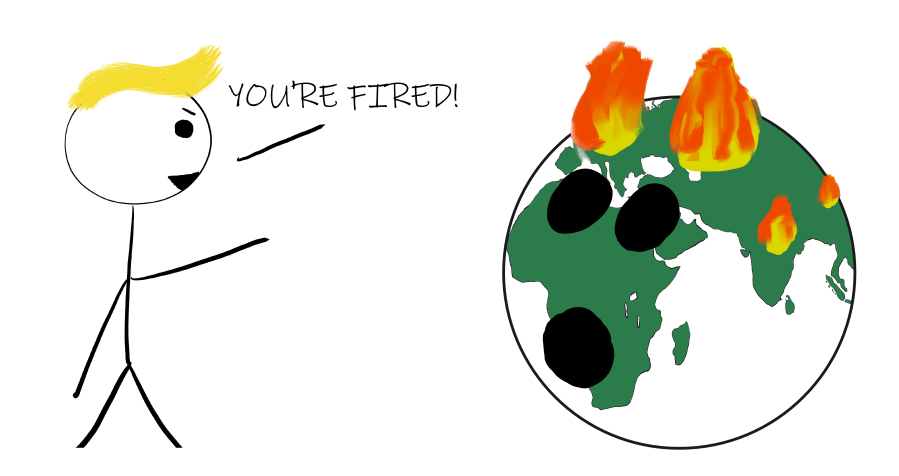
On January 20th, 2017, Donald J. Trump was inaugurated as the 45th president of the United States of America. As a conservative Republican candidate, he ran on a populist platform and promised to, amongst other things, ban Muslims, implement tax cuts, find an alternative to Obamacare, negotiate better trade deals, and build a wall on the border with Mexico.
Since then, the world has continued to keep close attention to news from the White House. We are all familiar with the effect the Trump administration has on the world of politics, but what about the one it is having on the world of science? Let’s take a quick look.
As President Trump took office, he promised that he would surround himself with the “best people” and “greatest minds”. Which is why it is a bit jarring that the White House still hasn’t appointed a science advisor, making this the longest period without one since the post was introduced in the time of President Eisenhower. In fact, the current highest ranking official in the White House science policy agency has a bachelor degree in political science.
To his credit, Trump tried filling the vacant slot by hiring Bill Gates, to which the philanthropic billionaire responded: “That’s not a good use of my time”. One of his reasons being, that he wants to prevent his philanthropic foundation from becoming politicized, and another that he believes that he can an do more good in his current role.
The Gates foundation, ran by Bill and his wife Melinda, helped reduce child mortality from 11 to “only” 6 million per year in the past twenty years. “If there are people who’ve used political lobbying to save that many lives then maybe I missed a trick,” Gates commented, after being asked why he doesn’t spend more of his money on lobbying.
There was also some controversy surrounding another billionaire – engineer and entrepreneur Elon Musk and his seat on Trump’s advisory councils. The well-known CEO of Tesla, SpaceX, and Neuralink joined one of Trump’s councils in late 2016 (and another in early 2017). In his role there, Musk strongly supported immigration and called attention to the threat of global warming. But his stint on the advisory councils ended after he threatened to leave if Trump pulled out of the Paris agreement on climate change mitigation. Which Trump had, to the disappointment of the rest of the member countries, on June 1st, 2017. After Musk’s departure, most other members of Trump’s councils also left, forcing the boards to be disassembled.
Pulling out of the Paris climate accord is arguably one of the most impactful decisions in Trump’s presidency to date. Under the guise of his “America first” policy, Trump sold the move to his supporters by saying that it will help support American workers and prevent any disadvantages that the economy of the United States would suffer under the agreement.

Needless to say, the international response to this decision was far from positive. In spite of this, other major players redoubled their support for the agreement – in fact, all other signatory countries were unanimous in their continued commitment to the accord.
Another campaign promise that Trump has been trying to deliver on, is the renewed focus on coal, both on its mining and its use in power plants. On June 1st, 2018, the Trump administration issued a memo, that would force power grid operators to buy electricity from unprofitable coal and nuclear plants, which have recently been struggling to compete with natural gas and renewable energy solutions. The reason for this particular memo seems to be that Trump believes coal plants to be “bomb proof”. Which is a fallacy – the coal infrastructure isn’t more resilient than competitive energy solutions, while it is extremely damaging to human health and is a big driver of climate change.

As for Trump’s promise to bring back coal mining jobs, a once important part of the US economy, not much has changed. Automation has replaced most of the workforce needed in the industry and bringing back redundant jobs would only make the coal companies less competitive, which wouldn’t help the industry in the long run.
Coal used to produce more than half of the electricity in the United States, whereas today, due in part to stricter environmental policies from the Obama administration, that number dropped to about 30%. While coal workers feel optimistic about their prospects, the numbers show that not much has changed. In the first eight months of Trump’s presidency, there were approximately 2000 new jobs created.
Even though coal production has increased slightly, the consumption of coal fell to record lows for the second year in a row.
Where coal is improving is in its export. In 2017 there was a 60% increase over the previous year, even though some experts attribute these increases to factors in international markets unrelated to Trump’s policies and will most likely prove to be temporary. But if he succeeds in stopping the “war on coal”, the end result will be worrisome. Coal has long been considered as one of the least favorable sources of energy and would represent a dirty step backward for the US energy sector and, more importantly, for people’s health.
If we focus on the energy sector a bit more, fracking is another area where Trump is rolling back regulations put in place by Obama. Fracking (or hydraulic fracturing) is a process where water and a proppant (for instance sand) is injected into deep underground bores under very high pressure in order to extract previously inaccessible fuel reserves. This pressure cracks the underground rock formations in which natural gas is being held, enabling its extraction.
The process is very controversial and poses many environmental and health risks. Fracking is even believed to cause earthquakes in the affected areas.

These policies are being implemented by the Department of Energy, whose previous head was dr. Moniz, a nuclear physicist. But Trump’s replacement is Rick Perry – a man who wanted to dismantle said department in 2011 and who sports a bachelor’s degree in animal science.
To continue with Trump’s questionable choices for cabinet members, we need to look no further than the ill-suited Betsy DeVos – the current Secretary of Education, or the newly appointed NASA administrator – Jim Bridenstine, who has no background in science and used to deny the role of humans in climate change.
While on the topic of NASA, we can’t overlook Trump’s well-received directive to build a base on the Moon. Human crewed space exploration has seen no real progress in the past few decades, with most space agencies and companies focusing on plans to take humans to Mars.
Companies like SpaceX are (optimistically) planning on putting humans on Mars by 2024 and establishing a proper colony there mere years later. Most scientists agree that a Moon base would be of great help with that and other space-related endeavors.
Astronauts and engineers would be able to gain experience with living off-world before they would try establishing a base on Mars, hundreds of times further away; that would help save trillions in man-hours and resources. The project would also help bring some much needed public focus on space exploration.
But the directive itself doesn’t necessarily mean there will be any actual progress; the President hasn’t allocated NASA any extra resources with which they are to achieve these goals.

Another big space-related development was Trump ordering the creation of a whole new branch of the US military – the Space Force.
Its aim is to ensure that the US stays ahead of Russia and China in the militarization of space. Currently, there is a program in the Air Force called the United States Space Command, which oversees the military aspects of space. The reason for the creation of a whole separate branch would be similar to why the US created the Air Force after the Second World War – they realized that fighting in the air brings different challenges and thus needs different approaches than traditional warfare. And the same holds true for space – operations outside of the Earth’s atmosphere require greatly different tactics, equipment, and training than any other part of the military.

Although the majority of Trump’s decisions are having an objectively negative impact on science itself, such policies are now being met with ever-growing pushback from scientists and citizens alike. There has been a big surge in environmentalist and anti-disinformation (anti “fake news”) movements whose aim is to educate the population, which will undoubtedly help bring long-lasting benefits to our society.
Does the Trump administration spell doom for science? Hardly. Politicians from all over the world are trying to take advantage of the rapidly changing voter-bases and are running on pro-science platforms and ideas, while countries like China and India (the world’s largest polluters alongside the US) are investing billions into renewables. Some countries are even on track to hit their 2030 renewable energy targets a lot sooner – Sweden even by the end of 2018. Even though the current US administration seems to be taking some steps in the wrong direction, we should remind ourselves that this is only a temporary situation. Hopefully, we will be able to turn these experiences into a learning opportunity. And that’s what science is all about.
 Glass half cool