
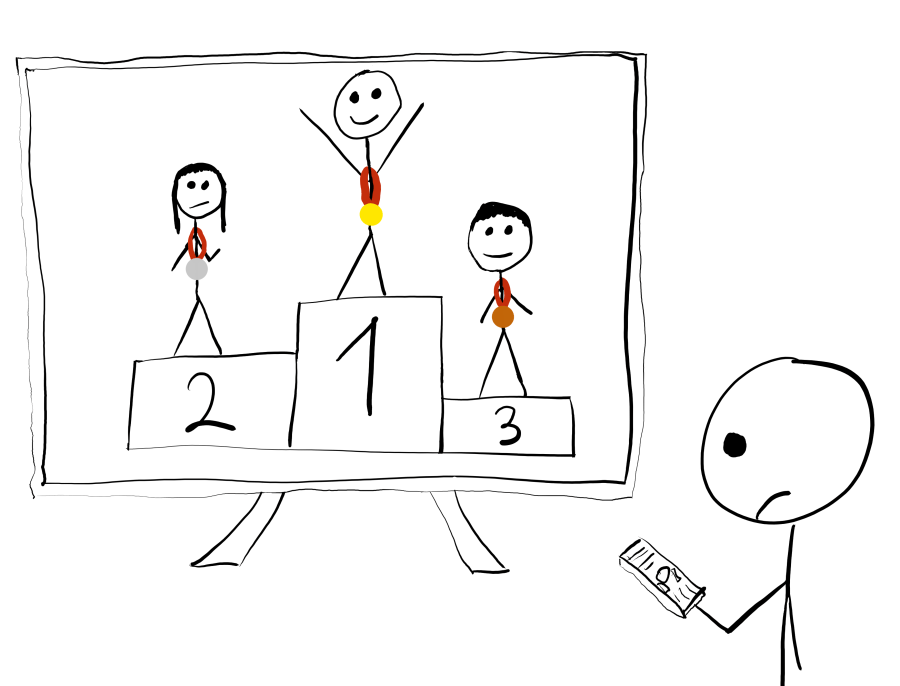
Many of us grew up being told that we can do anything we want if we just work hard enough for it. Want to be a doctor? Study for half of your life. A virtuoso musician? Devote your life to practice. The President? Send angry misspelled tweets in the small hours of the morning. But the reality is that because people covet a relatively small number of prestigious positions and achievements, most of us, by design, won’t ever reach them. This problem is exacerbated by the way our society glorifies celebrities and status. While there is nothing wrong with pursuing one’s dreams it is also important to learn to set realistic expectations. If a seventy-year-old man decided that he wanted to become the world triple-jump champion he’d have a virtually non-existent chance of achieving that dream no matter how hard he’d work for it.
 First, we need to define what it even means to be considered the best at something. In plenty of fields, success is something which is difficult to measure and is often very subjective. So, let’s look at an example where it’s difficult to dispute the results – sports. In individual sports, there is only one person who is the world champion or record holder in their discipline or event at any given time. But to broaden our “best people” pool a little bit, let’s add all of the athletes of a given discipline, who make it to the Olympics (sorry, other sports!). Very few would argue that those athletes represent the pinnacle of what humanity has to offer in the sports world. The percentage of athletes who make it into the Olympics is hard to estimate because it differs from sport to sport and the value varies wildly between individual countries.
No matter the difference between these numbers, all of them have one thing in common – the percentages are very low. Ice hockey, for instance, has 1.7 million registered players (about 200.000 of those being women) with only about 300 competing in the men’s tournament at the 2018 Winter Olympics (it should be noted that those who play in the NHL weren’t allowed to participate in 2018). That adds up to approximately 0.02%. Does that mean that the 99.98% of other athletes are considered failures? That depends on their own goals and definitions of success.

The main reason why the world champion, for example in skiing, is so celebrated and respected is because at some point in the past a large enough group of people decided that they think that strapping long pieces of wood to your feet and racing down slopes covered with snow is important enough for them to invest their time and money into the activity. The only things that ascribe something meaning are society and individuals themselves. For example, I’m not interested in my hypothetical neighbor’s antique coin collection, but there’s a surprising number of people from around the world who are willing (if not all able) to pay 10 million dollars for a coin because the coins have value to them.

The point I am trying to make is, that each of us decides what we find important and what we are willing to sacrifice in order to achieve those goals. I would argue that the most important goals we set shouldn’t be focused on being the best at something – no matter how good I would get at juggling, there would always be a kid somewhere who is better than me at age 5. What we should strive for is finding things that we genuinely enjoy, and try our best at those, no matter the result. If you hate doing something while you’re bad at it, chances are that you won’t start liking it as you get better. On the other hand, if you enjoy being horrible at something, your love for that activity will most likely scale up with your inevitable progress. I, for instance, found that falling off a surfboard for hours can be incredibly fun.
A cheesy piece of advice we often hear is “The only person you should compete with is yourself.” and I wholeheartedly agree. Do the best you can, but do it for yourself. No matter if your best means that you finally get to learn that one trick with a yo-yo, or set a personal triple jump record. In many cases, those dreams simply aren’t even realistic. Your genetics, environment, and plain luck all play too large a role in your opportunities and achievements.
And even if you do manage to fight your way to the top, you can’t remain there forever. World records get improved on constantly; mostly due to advances in training techniques and science. That means that sooner or later you lose a major part of your life and many athletes report suffering from depression after their retirement; a handful even committed suicide. Some of them likened the pain of retirement to that of losing a loved one.
Having such a singular focus in one’s life has considerable downsides, but that’s one of the sacrifices that reaching the very top requires. On the other hand, some athletes felt relieved and content with the end of their professional careers; mostly because they were finally able to focus on other aspects of their lives.
And on top of all that, there is an ever-growing number of activities at which machines are becoming better than people. Due to the spirit of sports, it’s my opinion that there will always be a place for it – sport is more about the athletes than about the disciplines themselves. But the truth of many games and activities is, that a human won’t be able to be “the best” at them ever again. Since Deep Blue beat Kasparov at chess in 1997, such systems have advanced to a point where, for instance, a self-taught artificial intelligence system can compete with top-level teams in video games like DotA (which is orders of magnitude more complex than chess). And the progress that artificial intelligence systems are making is incredible. It is definitely not a fair competition though – this particular AI plays more than 180 years worth of games in a single day. Artificial intelligence can nowadays do creative writing, create original paintings, and even compose symphonies. And there is nothing preventing this rapid progress.
 Let’s step out of the realm of futurology and return the focus back on us, humans. Being the best takes amazing discipline, dedication, and sacrifice. People who manage to reach their dreams and climb to the top serve as an inspiration for the rest of us. They are outliers – the select few who represent the very best of their respective fields. And here I am, writing a blog post about how it is okay to never become one of these people. Am I doing this to make myself feel better about my shortcomings and mediocrity? Maybe. But does comforting myself (and maybe some of you) need to be viewed in a negative way?
We can still look up to these people and not feel inadequate. Life isn’t about the successes we achieve, but about the experiences we live through and the happiness that we bring to ourselves and others. But don’t listen to me, I’m far from being the best at anything anyway.

 Glass half cool