ABSTRACT
In this paper, I will present the self-assembly method used to produce two and three-dimensional nanostructures called DNA Origami. I will briefly talk about its history, explain the theoretical background of this technique, present some interesting research into this technology, and touch upon what the future of this field might bring.
INTRODUCTION
DNA Origami uses the inherent selective pairing properties of a DNA molecule, to produce complex and programmable structures from strands of DNA, in the 100 nm size range. The name comes from the traditional Japanese art of folding paper into complex shapes, which is similar to how the strands of DNA are programmed to fold into themselves into various pre-programmed shapes and patterns. Here DNA is not used as genetic material but as a building material.
The history of DNA Origami started in the 1980s, when Nadrian Seeman proposed the idea, but the method of folding DNA strands into nanostructures as we know it today, hasn’t been introduced until Paul Rothemund developed the contemporary techniques in 2006 at the California Institute of Technology, for which his work was featured on the cover of Nature magazine. In March of 2016, there was a symposium titled “Ten years of DNA Origami” held by the Division of Engineering and Applied Science, to honor Rothemund’s contributions to the field and to take a look at the potential future applications of this method.
DNA Origami is a bottom-up building technique. That means that we take advantage of the self-organizational properties of the DNA molecule to build predetermined shapes.
The advantages of using a self-assembly method like DNA Origami is, that the building process is relatively cheap and simple, not requiring any extreme conditions, and the entire structure builds itself at once, instead of pixel by pixel. That presents many usage scenarios in various scientific fields.
This seminar is organized as follows. In the first section, I will cover the basics of DNA base pairing and how we use these principles to build nanostructures. In the second section, I will about how scientists come up with and design the required DNA sequences. In the third section, I will describe the advantages and disadvantages of DNA Origami in comparison to other nano-assembly methods. In the fourth part we will take a look at some interesting examples of research using this technology and in the fifth section, I will talk about alternatives to the technology.
PROPERTIES OF DNA ORIGAMI
DNA base pairing
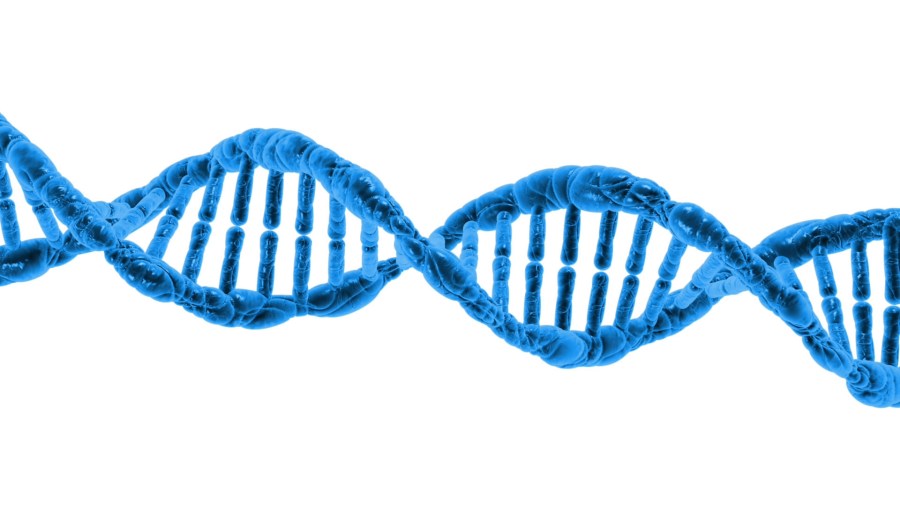
DNA’s double helix is 2 nanometres wide and has a twist that repeats about every 3.5 nm. The main property of DNA which is used in DNA Origami is its selective pairing. A DNA strand is built from four different building blocks – guanine, cytosine, adenine, and thymine – G C A T. What makes them interesting is the fact, that they form two complementary pairs. In molecular biology, complementarity is the relation between two structures, which follow a lock and key principle – in other words, they only bond to each other. DNA uses the complementarity of its base pairs to transcribe information from one generation to the next and to find errors in its sequence. This property of DNA is what makes it so compelling for scientists.
The base pairs of DNA bond themselves using hydrogen bonds, which are only possible between adenine (A) and thymine (T), where there is a double hydrogen bond, or between guanine (G) and cytosine (C), where we have a triple hydrogen bond. The reason for this is, that adenine and guanine belong to a group of nucleobases, which have a double-ringed chemical composition, called purines. That makes them physically bigger than their counterparts cytosine and thymine, which belong to a group of nucleobases with a single-ringed chemical structure, called pyrimidines.
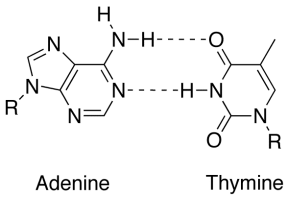
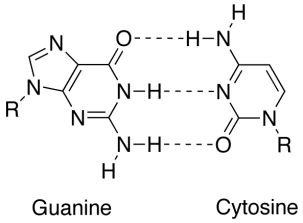
Purines are complementary only with pyrimidines, because pyrimidine-pyrimidine pairs are energetically unfavorable, due to the molecules being too far apart for a hydrogen bond to form, whereas purine-purine pairs aren’t energetically favorable because the molecules are too close, and repulsion forces become predominant, so again, the hydrogen bond cannot form.
These possible base pairs form the double helix spontaneously. In general, two DNA strands are fully complementary. But in cases when they are only partially complementary, each strand can accept multiple strands of DNA. That can form an intermediary structure with four arms called a Holliday junction.
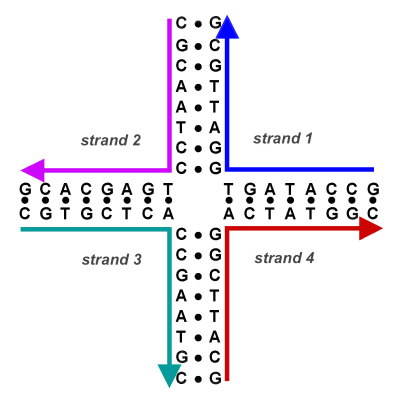
One of many possible configurations of a Holliday junction
These enable scientists to synthesize and fold many different shapes with the use of branched DNA structures such as stick cubes, branched crystals and tubes.
Scientists have already used the method to produce nanomechanical devices which can change shape, and even designed “walking” strands of DNA. The structures can have site-specific functionalization, exhibit machine-like traits, and can even behave as a logic gate.
Method of assembly
DNA Origami is folding long single-stranded DNA into the shape that we want using staples. Staples are small, short genomes, which have a right and left half.
To self-assemble DNA, we mix up the long strand and the staple strands into a saline solution, heat it up to almost boiling, and then cool it down in a process which de-naturates and then re-naturates the strands. When the sample is cooling down, the short strands bind to the predetermined bonding points on the long strand and start to form a rigid structure. The optimal length for the staple strands is between 17 and 50 bases. Due to the properties of the Watson-Crick base pairing, there is a combinatorially large number of sequences available for the binding interactions.
Designing the sequence
The process of designing the DNA sequence is carried out using a software program. There are a handful of open source options available. They started as simple 2D modeling programs and have now evolved to be able to design more complex 3D structures. The tools enable you to design arbitrary DNA Origami shapes and then generate the required sequences. The subsequent synthetization of DNA is a relatively fast and cheap process.
One such tool is the open-source software package called caDNAno. It provides the user with a graphical user interface which helps design the DNA sequences to form 3D structures. It works by organizing the strands of DNA into a honeycomb lattice and using algorithms (based on the properties of DNA Origami) automatically suggests the appropriate staple strand connections.

caDNAno interface
The first step is choosing which neighboring strands of DNA you want to add to the design. In this first window, we see a cross-section of the DNA strands in the honeycomb configuration. In the second window, we have the path panel, which shows us an unrolled 2D schematic of the sequences with the main scaffold (in blue) and the staples (in other colors) which bind them. During this step, we can add or remove the staples as we see fit. The suggested length for the staples is 18-49 bases, and the program highlights the ones which exceed that limit so the user can break the connection into multiple, shorter staples. The structures can still build themselves if we go over that limit, but the chance of mistakes in the assembly process is increased. In the last window, we have the real-time 3D model of our design.
When we design the desired shape, we can then synthesize the required scaffolding and staple strands and begin the process of assembly.
Advantages of DNA Origami over other nano-assembly methods
On the molecular scale, we have used various classes of molecules to build small, periodical structures. But problems arise when we’re trying to make these molecular classes build more complex structures. To program complex attractive interactions between the basic units, we need very specific interactions and bonding geometries between these basic units. One of the main issues with such structures is, that the “glue” between two basic units has to be selective, and only bond those two units and not any others. For most classes of molecules designing the required different components, and the various selective “glues” is a, currently unsurmountable, scientific challenge. Which is why building more complex structures from these classes of molecules is currently beyond our reach.
This is why scientists proposed the use of DNA in such scenarios since DNA is already built from complex basic components which are designed to bond to only very specific “glues”, the different basic building blocks only link to their counterpart in a lock and key type of interaction.
We are used to seeing DNA molecules in its double-stranded form, but it turns out that the molecule becomes too stiff in such a configuration. That is why scientists use a single strand of DNA as the scaffold material which can act like a lace-like base for the shorter staple strands. Thanks to its properties, DNA pairing is consistent, whereas RNA proved to be unsuitable for the task since it produces unexpected base-pairings. Experiments have been made to assure that DNA Origami is safe for biological applications and that it has long-lasting stability under operating conditions.
Another advantage of DNA Origami is the possibility of attaching virtually any small molecules, proteins or inorganic materials in various patterns and orientations which enables a plethora of usage scenarios.
Disadvantages of DNA Origami
Like all new technologies, DNA Origami comes with its disadvantages. And like with most fields of study, scientists are hard at work at overcoming these difficulties.
The great complexity of the technique brings with it some drawbacks. The first is the relatively low yield of early experiments. The typical yields were around 1% and that was achieved after several days of recombining the DNA strands. But there are recent advancements which promise to optimize the process. One of them is implementing a better understanding of the folding process to reduce the time the strands require for recombining from days to mere minutes, with yields approaching 100%.
Another drawback is the small production scale of the technique, but even here scientists are making considerable progress. The bottleneck is found in the fact that the short staple strands need to be programmed and produced one base at a time, whereas the scaffolding strand can be produced on a large scale using biotechnological processes. One proposed solution to this problem is to produce the staple strands as one long strand of DNA and then breaking them up into smaller parts after their synthetisation which enables high volume production. Scaling up the production to commercially viable levels seems to be within grasp.
Another problem facing researches is the difficulty of building larger and more complex objects. Early attempts were on a kilodalton scale – samples typically consisted of a few dozen strands. By using many staple strands, DNA Origami has opened the doors to megadalton-scale nanostructures which consisted of hundreds of unique strands. And while the difficulty of building structures using increasingly longer strands increases, there are new methods which work around this; one of them is called DNA bricks. The bricks are assembled separately from each other and then have them interlock. DNA bricks allow us to assemble structures in the gigadalton range, with tens of thousands of unique strands. The field is advancing at a fast pace.
The current price of such building material formed in a lab is about 20€ per milligram. But in a large-scale mass production scenario at a biotech facility, the production cost for a milligram of folded DNA Origami is estimated to reach around 0.20€ which would make it 1000x cheaper than competing conventional methods. Such scalability of production methods could open the doors for large-scale applications of the technology.
Uses
So far DNA Origami has mostly been used to design intricate patterns and shapes, which are interesting from an academic standpoint, but now the field is turning its focus towards applications of the technology. Most of the research so far has been used as a sort of proof of concept, but the next step for scientists is making the technology viable for use in the various fields.
One such usage scenario involves using DNA as a storage medium. One gram of DNA can store about 700 terabytes of information and could theoretically store that information for millions of years. Such a storage medium would require but a fraction of the energy required by today’s storage methods and would be orders of magnitude cheaper to implement. One kilogram of material could store all of the (current) world’s data. But there are downsides for such an application of the technology. The process is currently expensive, there is a relatively high number of mistakes during encoding and the storage process is incredibly slow – current methods of DNA storage can write a few hundred bytes per second, compared to gigabytes per second of modern SSD drives. Due to this, the technology wouldn’t work in scenarios which require fast write or read speeds, so it could only be utilized as a long-term storage solution, once we overcome the cost and reliability problems.
DNA Origami holds a lot of promise for targeted drug delivery systems as well. We can build a hollow capsule-like shape which can carry a drug within it, and have it closed by a latch which opens only in the proximity of its target. Such biological nanorobots could one day transport molecular payloads directly to cancer cells, thus shrinking the tumor with minimal damage to healthy tissue.
DNA has even been successfully designed to produce functional nanomechanical devices. Scientists were able to build molecules which can “walk” along DNA strands, and even some which can change shapes (similarly to the aforementioned targeted drug containers).
Another use for the technology is in the field of computing. Molecular logic circuits can be built using DNA Origami scaffolds. While there are multiple ways to organize nanocircuits, DNA Origami is used in the “breadboard” approach, which is inspired from classical electronics and consists of a 2D “board” on which the various circuit elements are then organized. The circuit is created by adding the necessary components to the ends of the DNA staples which ensure that the elements bind to their proper places on the board. Then we can get rid of the DNA with chemical processes and are left with a nanocircuit which can be one-tenth the size of traditional circuits. And scientists are working on many more applications of the technology.
Alternatives
In physics, we already use various top-down methods for building structures on such small scales, for instance, photolithography, dip-pen lithography, as well as atomic force (AFM) and scanning tunnel (STM) microscopy. But all of these methods have various shortcomings, the most obvious being expensive equipment, and the fact that we have to build these structures one pixel, or one line at a time, which makes them slow. With the exception of the dip-pen lithography method we are only able to build these nanostructures under very specific conditions; by utilizing a high vacuum, having a super clean chamber, or building in temperatures approaching absolute zero.
Another alternative is brought by recent advancements in nano-scale 3D printing. Using the two-photon lithography method, we can create complex structures using a specially designed raisin and a focused laser beam which is guided by movable mirrors. With a resolution of a few hundred nanometres, it is still two orders of magnitude larger than DNA Origami and does not use organic materials for its construction. While scientists are working on bio-compatible resins, the method currently cannot be used in medical applications.
CONCLUSION
In recent decades, nanotechnology has become one of the hottest areas of research. Being able to control materials on the nano-scale brings with it many applications which used to be beyond the realm of possibility. There is no denying that DNA Origami is a versatile and promising technology with many interdisciplinary applications. Medicine, computer science, and nanorobotics are only a few of the fields which could see advances due to the technology. Like with every new technology there are still plenty of challenges to overcome, but nonetheless, the future looks promising. As long as research on the topic continues, we might be witness to many more scientific breakthroughs in the future.
Gaber I
Sources:
[1] Mashaghi A, Katan A (2013), A physicist’s view of DNA, De Physicus. 24e (3):
59–61.
[2] Jeanette Nangreave, Dongran Han, Yan Liu, Hao Yan, DNA origami: a history
and current perspective, Current Opinion in Chemical Biology, Volume 14, Issue
5, October 2010, Pages 608-615
[3] Paul W. K. Rothemund, Folding DNA to create nanoscale shapes and patterns,
Nature Vol 440, 16 March 2006
[4] Practical DNA, Nature 531 editorial, 276, 15 March 2016
[5] XiaoZhi Lim, The architecture of structured DNA, Nature volume 546, pages
687–689 (29 June 2017)
[6] Watson JD, Crick FH (April 1953). Molecular structure of nucleic acids; a
structure for deoxyribose nucleic acid. Nature. 171 (4356): 737–8
[7] Pray, Leslie, Discovery of DNA structure and function: Watson and Crick,
Nature Education, 27 November 2013.
[8] Adenine Thymine bond, https://en.wikipedia.org/wiki/Base_pair#/media/File:Base_pair_AT.svg
[9] Guanine Cytosine bond, https://en.wikipedia.org/wiki/Base_pair#/media/File:Base_pair_GC.svg
[10] Watson JD, Crick FHC, A structure for deoxyribose nucleic acid, Nature, 1953;
171:737–738
[11] Mao, Chengde (December 2004). The Emergence of Complexity: Lessons from
DNA, PLoS Biology 2 (12): 2036-2038
[12] Watson JD, Crick FHC, A structure for deoxyribose nucleic acid, Nature, 1953;
171:737–738
[13] Seeman N.C,.Structural DNA Nanotechnology In: Rosenthal S.J., Wright D.W.
NanoBiotechnology Protocols. Methods in Molecular Biology, vol 303. Humana
Press 2005
[14] Chao Zhou, Xiaoyang Duan, Na Liu, A plasmonic nanorod that walks on DNA
origami, Nature Communications volume 6, Article number: 8102 (2015)
[15] Dongfang Wang, Yanming Fu, Juan Yan, Bin Zhao, Bin Dai, Jie Chao, Huajie
Liu, Dannong He, Yi Zhang, Chunhai Fan, and Shiping Song, Molecular Logic
Gates on DNA Origami Nanostructures for MicroRNA Diagnostics, Analytical
Chemistry 2014 86 (4), 1932-1936
[16] Watson JD; Baker TA; Bell SP; Gann A; Levine M; Losick R., Molecular Biology of the Gene (5th ed.), 2004, Pearson Benjamin Cummings: CSHL Press.
[17] Luvena L. Ong , Nikita Hanikel, Omar K. Yaghi, Casey Grun, Maximilian T.
Strauss, Patrick Bron, Josephine Lai-Kee-Him, Florian Schueder, Bei Wang, Pengfei Wang, Jocelyn Y. Kishi, Cameron Myhrvold, Allen Zhu, Ralf Jung-mann, Gaetan Bellot, Yonggang Ke, Peng Yin, Programmable self-assembly of three-dimensional nanostructures from 10,000 unique components – Nature vol. 552, 7. December 2017
[18] Shawn M. Douglas, Adam H. Marblestone, Surat Teerapittayanon, Alejandro
Vazquez, George M. Church and William M. Shih, Rapid prototyping of 3D
DNA-origami shapes with caDNAno, Nucleic Acids Research, 16 June 2009,
Vol. 37
[19] Hajime Shigemitsu, Toshiyuki Kida, Preparation of nano- and microstructures
through molecular assembly of cyclic oligosaccharides, Polymer Journal volume
50, pages 541–550 2018
[20] Thomas Tørring and Kurt V. Gothelf, DNA nanotechnology: a curiosity or a
promising technology?, F1000Prime Reports 2013
[21] Sobczak J-PJ, Martin TG, Gerling T, Dietz H, Rapid folding of DNA into
nanoscale shapes at constant temperature, Science 2012
[22] DNA-origami surpasses important thresholds: Building virus-sized structures and saving costs through mass production.ŠcienceDaily. ScienceDaily, 6 Decem-
ber 2017.
[23] Florian Praetorius, Benjamin Kick, Karl L. Behler, Maximilian N. Honemann,
Dirk Weuster-Botz, Hendrik Dietz, Biotechnological mass production of DNA
origami, Nature volume 552, pages 84–87, 7 December 2017
[24] Luvena L. Ong, Nikita Hanikel, Omar K. Yaghi, Casey Grun, Maximilian T.
Strauss, Patrick Bron, Josephine Lai-Kee-Him, Florian Schueder, Bei Wang, Pengfei Wang, Jocelyn Y. Kishi, Cameron Myhrvold, Allen Zhu, Ralf Jungmann, Gaetan Bellot, Yonggang Ke, Peng Yin, Programmable self-assembly of three-dimensional nanostructures from 10,000 unique components, Nature,
volume 552, pages 72–77, 7 December 2017
[25] K.F. Wagenbauer et al., Gigadalton scale shape-programmable DNA assem-
blies, Nature 2017
[26] Florian Praetorius, Benjamin Kick, Karl L. Behler, Maximilian N. Honemann,
Dirk Weuster-Botz, Hendrik Dietz, Biotechnological mass production of DNA
origami, Nature volume 552, pages 84–87 7 December 2017
[27] Nick Goldman, Paul Bertone, Siyuan Chen, Christophe Dessimoz, Emily M. LeProust, Botond Sipos, Ewan Birne, Towards practical, high-capacity, low-
maintenance information storage in synthesized DNA, Nature volume 494, pages 77–80, 07 February 2013
[28] Nick Goldman, Paul Bertone, Siyuan Chen, Christophe Dessimoz, Emily M. LeProust, Botond Sipos, Ewan Birney, Towards practical, high-capacity, low-
maintenance information storage in synthesized DNA, Nature volume 494, pages 77–80, 07 February 2013
[29] Yonggang Ke, Jaswinder Sharma, Minghui Liu, Kasper Jahn, Yan Liu and Hao
Yan, Scaffolded DNA Origami of a DNA Tetrahedron Molecular Container, Department of Chemistry and Biochemistry and The Biodesign Institute, Ari-
zona State University, Centre for DNA Nanotechnology and iNANO, Aarhus University, Aarhus, Denmark DK-8000, Letters 2009 Vol. 9, No. 6
[30] Zhou, C., A plasmonic nanorod that walks on DNA origami, Nat. Commun.
2015
[31] Alexander E. Marras, Lifeng Zhou, Hai-Jun Su, Carlos E. Castro, Programmable
motion of DNA origami mechanisms, Proceedings of the National Academy of
Sciences, Jan 2015
[32] André Estevez-Torres and Yannick Rondelez, DNA Computing – Spatially localized DNA domino, Nature nanotechnology, 24 July 2017
[33] Jaschke, M.; Butt, H.J.,Deposition of Organic Material by the Tip of a Scanning
Force Microscope, Langmuir. 11: 1061–1064
[34] https://phys.org/news/2012-03-3d-printer-nano-precision.html
 Glass half cool

